SPD88 Login Malaysia
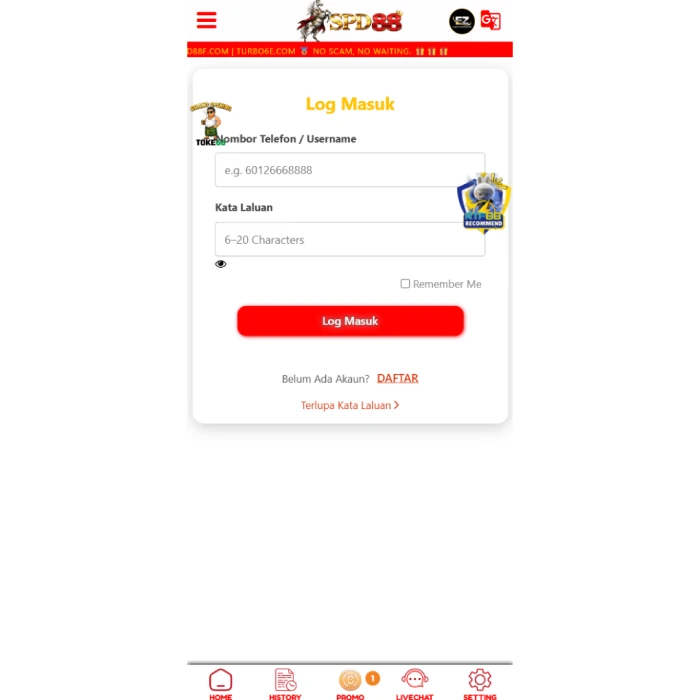
This is an information guide, not a login pageSPD88MY.com does not collect usernames, passwords or account information. Always log in on the correct, verified platform.
This SPD88 login guide is for Malaysian users who want to understand how account access usually works and what safety checks to follow before entering login details. Users may search for SPD88 login, SPEED88 login, SPD88C login, SPD88 log masuk or SPD88 masuk.
SPD88 login overview
Users searching for SPD88 login, SPEED88 login, SPD88C login, SPD88 log masuk or SPD88 masuk are almost always existing account holders who want fast, correct account access — not new information about the brand. This guide is written for exactly that intent, while still keeping the safety checks that matter most for a casino-style account.
Because casino login pages are a common phishing target in Malaysia, the single most important habit on this page is not a step in the login flow itself — it's the habit of checking the domain every single time, not just the first time.
How to login to SPD88
- Visit the correct SPD88 / SPEED88 access page.
- Check that the website address is correct.
- Select Log Masuk or Login.
- Enter your username or phone number.
- Enter your password.
- Complete any verification step if required.
- Confirm your balance and recent activity after login.
Do not enter login details on pages that look copied, broken or suspicious. If anything about the page looks slightly different from your last visit — a different logo size, layout or colour — treat that as a reason to stop and re-verify rather than assume it is a minor update.
Logging in via mobile browser vs the app
Which login route you use changes your risk profile slightly. Browser login relies on you correctly typing or bookmarking the right address each time; app login relies on the app itself being genuine and safely installed in the first place. Neither is automatically safer — each simply shifts where your verification effort needs to go.
| Login route | What to verify | Main risk |
|---|---|---|
| Mobile / desktop browser | The domain address, every time you visit | Typo-squatting or a lookalike domain |
| Installed app | The app's source and permissions, once at install time | A fake or tampered APK installed in the first place |
If you use the app route, see our app guide for the install-safety checklist before you ever reach the login screen itself.
Spotting a fake or copied SPD88 login page
Phishing pages are usually built to look almost identical to the real thing, so small details matter more than overall appearance. A typical fake login page might use a domain such as an extra hyphen, a swapped letter, or an unfamiliar extension in place of the one you originally verified — for example, a lookalike domain that inserts or removes a character your eye can easily skip past when you're in a hurry.
- Read the domain slowly, character by character, before entering anything.
- Check for a valid, current HTTPS connection (the browser's padlock icon).
- Be suspicious of pages reached via a shortened link (bit.ly-style) rather than a typed or bookmarked address.
- Be extra cautious of links shared in Telegram or WhatsApp broadcast groups, even if they look official.
- If a page asks for more information than a login normally requires — such as your full card number — stop immediately.
When in doubt, don'tIf you cannot confirm a login page is correct, close it and navigate back to the source you verified previously rather than guessing.
Common login problems
| Problem | Possible cause | What to do |
|---|---|---|
| Wrong password | Typing error or forgotten password | Use password reset |
| Account locked | Too many failed attempts | Contact support |
| Page not loading | Network or server issue | Try again later |
| Redirects appear | Unsafe link or mirror page | Stop and verify the source |
| Balance looks wrong | Account / payment issue | Contact support immediately |
| Login accepted but page looks different | Possible phishing page mimicking the real one | Log out, change your password from a verified source, and monitor your account |
| Stuck on a loading spinner | Server load, browser cache issue, or weak connection | Wait briefly, then clear your browser cache and retry |
| Login works on browser but not app (or vice versa) | One of the two may be outdated or pointing to a different source | Re-verify both routes against your originally confirmed domain |
Clearing your browser's cache and cookies is a simple fix worth trying before contacting support — old cached data can sometimes cause a login page to behave unpredictably, especially after the platform has updated its site.
Forgot password guide
If you forget your password, use the platform's official reset process. Do not share your password with agents, public groups or unknown support accounts. A safe password reset should never require you to reveal your current password to another person.
When you do reset your password, choose one you have not reused anywhere else — especially not your email or banking password — and consider writing it down in a private password manager rather than a note-taking app synced to the cloud.
If you've lost access entirely
Losing access to both your password and your registered phone number or email is more serious than a simple forgotten password, because most self-service reset flows depend on reaching at least one of them. In that situation, expect to go through a manual account-recovery process that may ask you to confirm details only the real account owner would know — such as recent deposit amounts, registration date, or linked payment details. Treat any recovery process that skips this kind of verification as suspicious, since a legitimate process protects the account precisely by not making recovery too easy.
Building a strong, unique login password
A strong password is less about complexity for its own sake and more about two things: length and uniqueness. A longer passphrase built from unrelated words is often both easier to remember and harder to guess than a short string of substituted symbols.
- Aim for at least 12 characters — a short phrase beats a short jumble of symbols.
- Never reuse your email, banking or social-media password for a casino-style account.
- Avoid obvious personal details — birthdates, phone numbers or your own name.
- Consider a password manager to generate and store a unique password per site.
- Change your password immediately if you suspect any unauthorised access.
One compromised account should stay containedThe entire point of a unique password is damage control — if one account is ever exposed in a data leak, a unique password means the damage stops there instead of spreading to your email or bank.
OTP and verification codes: what's normal, what's a scam
A one-time password (OTP) or verification code is a short-lived code sent to confirm it is genuinely you performing an action such as logging in, resetting a password or making a withdrawal. Treat the following as a hard rule, not a guideline: nobody legitimate — not support staff, not an 'agent', not a friend offering to help — ever needs you to read an OTP out to them.
| Situation | Normal | Scam pattern |
|---|---|---|
| OTP arrives when you requested one | Yes, expected | N/A |
| OTP arrives without you doing anything | No | Someone else may be trying to access your account — do not share it, and change your password |
| Someone asks you to read the OTP to them by phone or chat | Never legitimate | Classic account-takeover scam |
| A page asks you to enter an OTP twice, on two different sites | No | The second site may be capturing your code for itself |
If you ever receive an OTP you did not request, treat it as an active signal rather than a curiosity — someone else likely has your username or phone number and is one step away from your account. Change your password immediately from a device you trust, and check your recent account activity for anything unfamiliar once you're back in.
Safe login checklist
Treat this as a habit to run through quickly before every login on a new device or network, not just a one-time setup task.
- Check the domain before login
- Avoid login on public Wi-Fi
- Do not save your password on shared devices
- Use a strong, unique password
- Avoid clicking random Telegram or WhatsApp links
- Log out after using a shared phone
- Report suspicious account activity quickly
Public Wi-Fi specificallyCafe, mall and public transport Wi-Fi networks are convenient but easier for others on the same network to intercept unencrypted traffic on. If you must use public Wi-Fi, prefer your mobile data connection for anything involving login or payment details instead.
Logging in on shared or public devices
Family computers, cybercafé terminals and borrowed phones are common in Malaysian households, but they are a poor choice for casino-account logins. Shared devices may have saved autofill data, unknown browser extensions, or other users who can simply reopen your last session.
- Use a private browsing / incognito window if you must use a shared device.
- Always log out manually — do not just close the tab.
- Decline any 'remember me' or 'save password' prompt on a device you do not own.
- Clear the browser history and cache afterwards if the device is shared regularly.
What happens during a login session
When you log in successfully, the platform typically creates a temporary 'session' that keeps you recognised as you move between pages, so you are not asked to re-enter your password on every click. This is normal and convenient, but it is also why logging out matters on any device you don't fully control — an open session can sometimes be reused by the next person on that device without needing your password at all.
If you ever see account activity you don't recognise — a game history entry, a balance change, or a withdrawal you didn't request — treat it as a sign that a session or password may have been compromised, log out of all sessions if the platform allows it, change your password immediately from a device you trust, and contact support.
Malaysian phishing patterns to watch for
Malaysian users are frequently targeted through WhatsApp and Telegram broadcast messages promising a 'new alternative link', an urgent 'account verification', or a limited-time bonus tied to a login page. These messages create urgency on purpose, because urgency makes people skip the domain-checking habit described above. A message claiming your account will be suspended unless you 'log masuk' immediately through a provided link is a textbook pressure tactic, regardless of which brand name it uses.
If you receive an unexpected login link through a messaging app, do not tap it. Open your browser separately and navigate to the source you already verified, or use the app guide to confirm the correct access route first.
Another common pattern involves fake 'customer service' accounts on Telegram or WhatsApp using logos and names very close to the real brand, offering to 'help you log in' or 'recover your account' directly through chat. Legitimate support does not need your password or OTP to help you — if a support contact asks for either, that alone is enough reason to stop the conversation and verify through the platform's own official channel instead.
Worked example: an urgent 'verify your account now' message
Imagine you receive a WhatsApp message: 'Your SPD88 account will be suspended in 1 hour unless you verify now — click here to log masuk.' The message includes a link that looks similar to the address you remember. This is a textbook phishing setup: manufactured urgency, a plausible-looking link, and a request to log in immediately.
The safe response is to do nothing with that link. Instead, open your browser separately, navigate to the address you previously verified (ideally from a saved bookmark), and check your account status directly. If there genuinely is an account issue, it will still be visible after logging in the correct way — a legitimate issue does not disappear because you took five extra minutes to verify the source first.
Browser settings that make login safer
A few small browser habits reduce login risk across every site you use, not just a casino-style account.
- Keep your browser and phone operating system updated — many updates patch security issues used by phishing kits.
- Enable your browser's built-in phishing/malware protection if it isn't already on by default.
- Periodically review saved passwords and remove any you no longer use.
- Use a bookmark for your verified login page instead of retyping or re-searching it each time.
- Consider a separate browser profile or a password manager that only autofills on the exact, correct domain — this is a useful phishing check, since it will not autofill on a lookalike domain.
Login terms glossary
| Term | Meaning |
|---|---|
| Log masuk | Bahasa Malaysia for 'login' |
| OTP | One-time password — a temporary verification code, never to be shared |
| Phishing | A fake page or message designed to steal login or payment details |
| Mirror / alternative link | A backup or duplicate domain; verify separately before trusting it |
| Session | A single logged-in period on a device; ending it (logging out) protects shared devices |
| Two-factor / verification step | An extra check beyond your password, such as an OTP |
| Password manager | An app that generates and securely stores a unique password for each site you use |
| Account takeover | When someone else gains unauthorised control of your account, often via a stolen password or OTP |
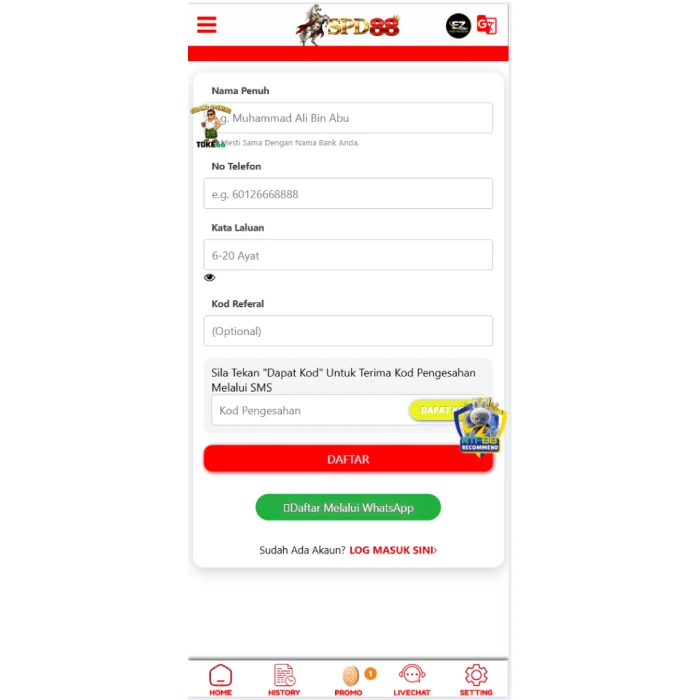
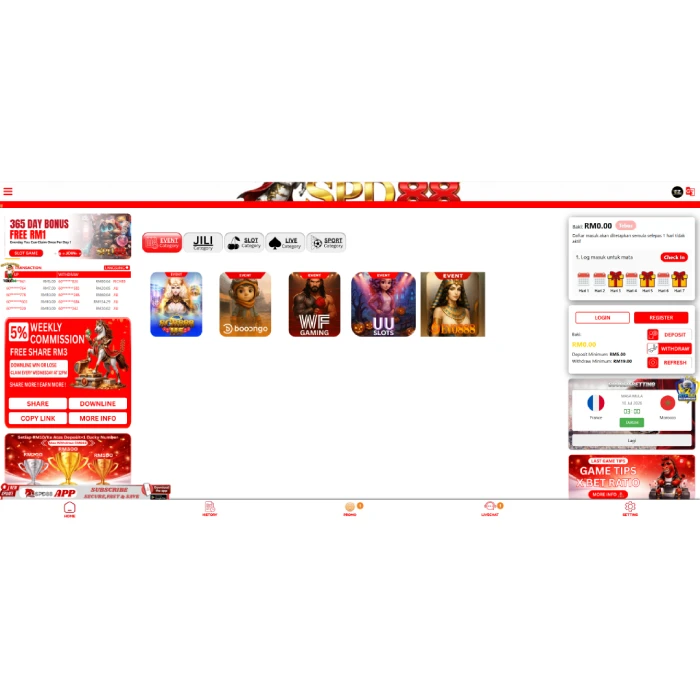
SPD88 platform screenshots
Frequently asked questions
Is this the official SPD88 login page?
No. This is an informational guide for SPD88 login-related searches. It does not collect account details and is not an official login area.
Why can I not login to SPD88?
Common reasons include a wrong password, an account lock, a server issue, an incorrect link or unstable internet.
What does log masuk mean?
Log masuk means "login" in Bahasa Malaysia.
Should I login through an APK?
Only use an app or APK from a verified source. Fake APKs can steal your login information.
What should I do if my account balance is wrong?
Stop playing and contact support through a verified channel. Take screenshots of your account activity and payment records first.
How do I recognise a fake SPD88 login page?
Compare the domain character by character against the source you originally verified, check for a valid HTTPS connection, and be suspicious of pages reached through a shortened link or a random Telegram/WhatsApp broadcast rather than a bookmark you saved yourself.
Is it safe to save my SPD88 password in my browser?
Only on a private device you control, ideally using a dedicated password manager rather than a plain browser autofill. Never save it on a shared, public or borrowed device.
What is an OTP and why did I receive one?
A one-time password (OTP) is a temporary code used to verify it is really you logging in or making a change. Never share an OTP with anyone, including someone claiming to be support staff — legitimate staff will not ask for it.
Can I log in to SPD88 on more than one device?
This depends on the platform's current session rules, which this guide cannot confirm. If you notice a login session you do not recognise, change your password and contact support immediately.