Responsible Gaming
18+ only — gambling involves financial riskCasino games, slots, live casino and 4D outcomes should be treated as entertainment only, not as a way to earn income. If gambling causes stress, debt, secrecy, conflict or loss of control, stop and seek support.
Gambling involves financial risk. This page provides responsible-gaming reminders for Malaysian users, including warning signs, budgeting, taking breaks, supporting others and getting help. It applies to every game type referenced across this site — slots, live casino, fishing games and 4D-style features alike.
Gambling risk reminder
Every gambling activity can lead to loss. No bonus, game provider, pattern or strategy can guarantee profit. Never gamble with money needed for rent, food, bills, family support, loan payments or savings.
This applies equally to every format discussed on this site — slot spins, live-dealer tables, fishing-style arcade games and 4D-style number draws are all built so that, over time, the platform's edge and the unpredictability of the outcome work against a player trying to rely on winnings. Short-term wins can and do happen; they are not evidence that a method or pattern has been found.
The safest financial position is to treat every ringgit deposited as already spent the moment you deposit it — the way you would treat the price of a cinema ticket or a meal out. If a win happens, treat it as a pleasant surprise, not a result to expect again.
Gambling is not income
Casino games are not a job, an investment or a financial plan. If a website, agent or promotion suggests guaranteed profit, treat that as a major warning sign.
Be especially cautious of anyone — an 'agent', a group chat, a social-media contact — who claims to have a system, formula or insider pattern for winning consistently. These claims are common marketing tactics precisely because random outcomes occasionally look like a working pattern for a short stretch, which is enough to convince someone to keep paying for 'tips' or depositing more.
Common gambling myths, debunked
Several persistent myths make gambling feel more predictable or controllable than it actually is. Recognising them is one of the most practical harm-reduction tools available, because myths are often what convince someone to deposit 'just one more time'.
| Myth | Reality |
|---|---|
| A game is 'due' for a win after many losses | Most casino-style games use independent outcomes — past results do not influence the next one |
| A 'hot streak' means the game currently favours you | Short winning or losing runs happen naturally in random systems and are not a signal to chase |
| Betting bigger after a loss will recover it faster | This raises risk of a larger loss faster; it does not change the underlying odds |
| Free credit or bonuses mean there's no real risk | Wagering requirements still apply, and time spent chasing them still carries risk |
| 4D numbers can be predicted with a formula or 'bocor' tip | Draws are random; no formula or leaked tip can guarantee a result |
| A trusted-looking agent's 'inside information' is reliable | No outsider has reliable advance knowledge of a random draw or game outcome |
Warning signs of problem gambling
None of these signs alone proves a problem exists, but the more of them you recognise in yourself or someone close to you, the more seriously they deserve attention.
- Chasing losses
- Borrowing money to gamble
- Hiding gambling from family
- Feeling anxious when not playing
- Depositing more than planned
- Gambling to escape stress
- Ignoring work or responsibilities
- Selling items or taking loans to play
A quick self-check
This is not a clinical diagnosis — it is a short, honest self-check. Answering 'yes' to several of these questions is a reasonable signal to slow down, take a break, or speak with a support service, not a reason to panic.
- Have you spent more time or money gambling than you intended to, more than once?
- Have you lied to someone about how much you gamble or how much you've lost?
- Have you tried to win back a loss with a bigger bet the same session?
- Have you felt restless, anxious or irritable when trying to cut back?
- Have you borrowed money, sold something, or used money meant for bills to keep playing?
- Has gambling caused an argument, missed work, or a broken promise to someone you care about?
If several answers were yesConsider taking a break immediately and speaking with a trusted person or a counsellor — see the Getting Help section below.
Set limits before playing
Before you play, decide your maximum deposit, maximum loss, maximum playing time, a clear stopping point, and whether any bonus is worth its restrictions. Once the limit is reached, stop.
Worked example: setting a simple session budget
Say your discretionary entertainment budget — money left over after bills, savings and essentials — is RM200 for the month. A cautious approach might split that into 2-4 sessions of RM50-RM100 each, rather than one RM200 session. Before each session, decide the number in advance, deposit only that amount, and treat reaching it as the end of the session, win or lose. If you find yourself wanting to deposit again after reaching your limit, that urge is exactly the moment this page is asking you to notice and pause on.
Protecting your finances beyond a session limit
A session limit works best when it sits inside a wider financial habit, not on its own. Paying bills, rent and essential commitments first — before any discretionary spending is even considered — means a bad gambling session can never accidentally touch money you needed for something else.
- Pay essential bills and savings contributions before setting aside any entertainment budget.
- Consider keeping gambling funds in a separate, clearly labelled account or e-wallet rather than mixed with everyday spending money.
- Avoid linking a credit line or 'buy now, pay later' facility to any gambling-related payment method.
- Review your bank/e-wallet statements periodically so spending patterns are visible, not just felt.
None of this guarantees anything, but it does reduce how much damage a single bad night can cause — which is the entire point of budgeting for entertainment with real financial risk.
Tools that can help you stay in control
Some platforms offer built-in account controls. Availability, names and effectiveness vary, so treat the list below as things to look for and ask about, not a confirmed feature set of any specific platform.
| Tool | What it typically does |
|---|---|
| Deposit limit | Caps how much you can add to your account in a day, week or month |
| Loss limit | Caps how much you can lose in a set period, regardless of deposits |
| Time-out / cooling-off | Temporarily blocks account access for a set number of days |
| Self-exclusion | Blocks account access for a longer period, sometimes permanently |
| Reality check / session timer | Shows a reminder of time spent or balance changes during play |
If a platform does not appear to offer any of these tools, you can create the same effect manually: set a personal calendar reminder, tell a trusted person your limit in advance, or simply avoid saving your payment details so that each deposit requires a deliberate extra step.
Combining a formal tool with a personal habit tends to work better than relying on either alone. A deposit limit stops you from adding more funds; a personal rule like 'I close the app after two losses in a row' addresses the behaviour a deposit limit alone can't reach.
When to take a break
Take a break if gambling no longer feels controlled. A break can protect your finances, mental health and relationships.
A break does not need to be dramatic to be useful. Even a fixed week away from any casino-style app or site can reset the urgency that keeps pulling you back, and it gives you a clearer, calmer moment to honestly assess whether a longer break — or stopping entirely — is the better choice.
If you're unsure how long a break should be, err on the side of longer rather than shorter. A break that ends the moment the urge fades is often too short to change the underlying pattern; a break measured in weeks, with a specific restart date you set in advance (or no restart date at all), gives the habit more room to actually loosen its grip.
Supporting a friend or family member
If someone close to you may be gambling more than they can afford, it can be hard to know what to say. A calm, specific and non-judgemental conversation tends to work better than confrontation — for example, naming a specific change you've noticed rather than a general accusation.
- Choose a private, calm moment rather than raising it in front of others.
- Focus on specific changes you've noticed, not labels or blame.
- Avoid covering their debts directly, which can unintentionally enable further gambling.
- Encourage them to speak with a counsellor, financial adviser or support organisation.
- Look after your own wellbeing too — supporting someone with a gambling problem can be stressful.
Keeping devices and accounts away from minors
If you share a household with children or other minors, treat casino-style apps and accounts the way you would treat any other adult-only content: logged out, not saved to autofill on a shared device, and not left open on a tablet or computer used by the family generally.
- Log out of any casino-style account on shared family devices.
- Avoid saving passwords or payment details in browsers on shared devices.
- Use your device's parental-control or app-restriction settings on devices minors use.
- Keep any related notifications or promotional messages away from shared or family group chats.
Getting help
If gambling feels difficult to control, speak with a trusted person, a financial adviser or a counsellor. In Malaysia, organisations such as the Malaysian Mental Health Association (MMHA) and Befrienders KL (a free, confidential emotional-support line) can help. Search for their current official contact details rather than relying on a number forwarded through a chat group.
If there is any immediate risk of self-harm, or you are otherwise in danger, contact local emergency services right away — Malaysia's national emergency number is 999.
If the harm is mainly financial — mounting debt, missed payments, borrowing to cover losses — a registered credit-counselling or debt-management service can help you build a structured repayment plan, separate from any conversation about the gambling itself. Addressing the financial side and the behavioural side together tends to work better than treating either in isolation.
You are not aloneReaching out early makes problem gambling far easier to manage. Support is confidential and available.
Malaysian and family context
In many Malaysian households, finances are shared or closely intertwined across generations, which can make gambling harm harder to hide — and also harder to admit. Festive periods such as Chinese New Year, Hari Raya and Deepavali often carry their own gambling-adjacent traditions and extra cash circulating through ang pow or duit raya, which can make it easier to lose track of a personal budget during those weeks specifically. Being aware of this seasonal pattern in advance can help you set a slightly stricter limit during festive periods, not a looser one.
4D and similar number-draw formats are deeply familiar in Malaysian culture, which can make them feel lower-risk than they actually are simply because they are so normalised. Cultural familiarity is not the same as financial safety — the same budgeting and limit-setting advice on this page applies to 4D-style play exactly as it does to slots or live casino games.
Workplace and peer culture matters too. Group betting pools, office jackpot chats or friends comparing wins can create quiet social pressure to keep up or to hide losses to save face. It is reasonable — and increasingly common — to opt out of a group activity like this without needing to justify the decision in detail.
Responsible-gaming glossary
| Term | Meaning |
|---|---|
| Chasing losses | Increasing bets or continuing to play specifically to try to win back money already lost |
| Self-exclusion | A tool that blocks your own account access for a set or indefinite period |
| Deposit limit | A cap on how much can be added to an account within a set period |
| Reality check | An in-session reminder of time played or balance change |
| Bankroll | The total amount of money you have set aside for gambling entertainment, not for essentials |
| Problem gambling | A pattern of gambling that causes harm to finances, relationships, work or wellbeing |
| Gambler's fallacy | The mistaken belief that past random outcomes affect the probability of future ones |
| Time-out / cooling-off | A short, temporary block on account access, often self-initiated |
| Discretionary budget | Money left over after essentials, savings and obligations — the only money that should ever be considered for gambling |
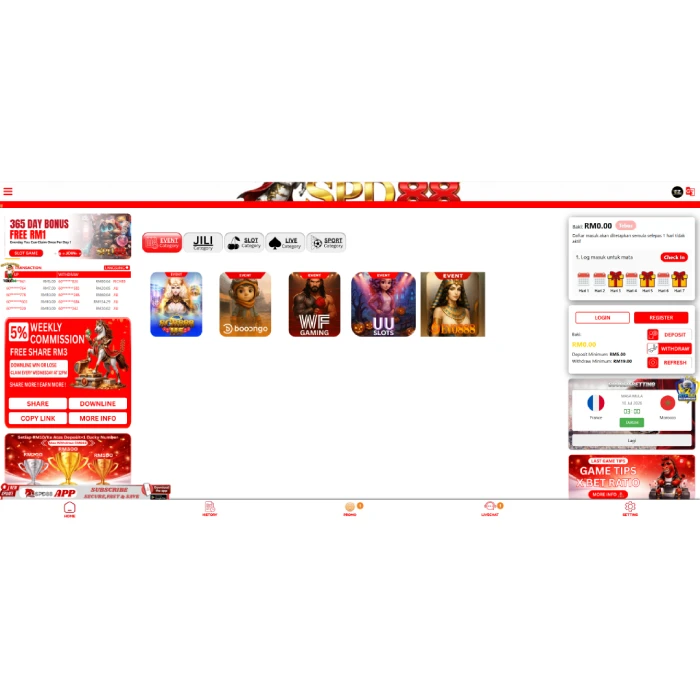
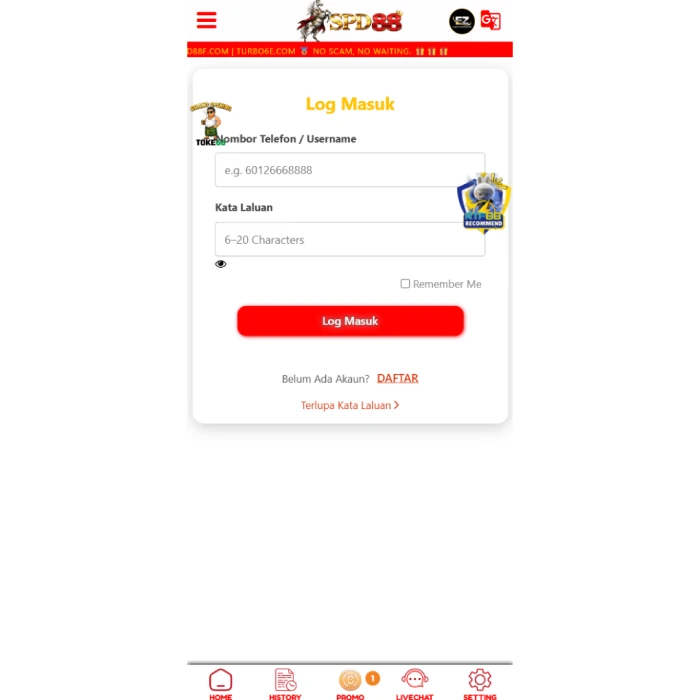
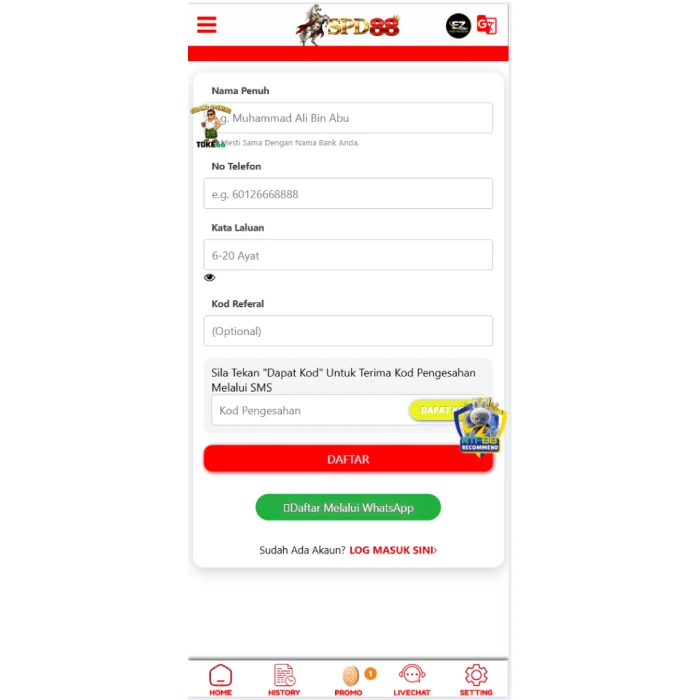
SPD88 platform screenshots
Frequently asked questions
Is gambling safe?
Gambling always involves financial risk. It should be treated as paid entertainment, never as a way to earn money.
Can gambling be income?
No. Gambling should not be treated as income, a job, an investment or a financial plan.
What should I do if I keep chasing losses?
Stop playing and seek help. Chasing losses increases harm. Set a firm limit and talk to a trusted person or support service.
Are bonuses risk-free?
No. Bonuses can encourage more gambling and may include strict terms. Treat them cautiously.
Should I set limits?
Yes. Decide your maximum deposit, loss and playing time before you start, and stop when you reach them.
Can a bonus make gambling riskier?
Yes. A bonus can encourage you to deposit more or play longer than planned in order to meet a wagering requirement. Treat any bonus as secondary to your own pre-set budget, never as a reason to raise it.
What is a deposit limit or self-exclusion tool?
These are account controls, offered by some platforms, that let you cap how much you can deposit or temporarily/permanently block your own access. Availability varies, so check what tools a specific platform currently offers.
How do I know if it's time to stop for good, not just take a break?
If gambling is affecting your relationships, finances, work, sleep or mental health repeatedly — not just once — that pattern is a stronger signal than any single bad session. Consider speaking with a counsellor or trusted support service.
How can I support a friend or family member who may be gambling too much?
Start with a calm, non-judgemental conversation, avoid covering their debts financially, and encourage them to speak with a trusted counsellor or support organisation. Supporting someone does not mean managing their gambling for them.